
Missed Signals: What Military Intelligence Can Teach Us
December 7, 1941, is the date President Roosevelt called one which would live in infamy. The story usually told about that morning is one of surprise. However the United States was not short on information about Japan. In fact, it was drowning in it.
The popular telling is that the warning signs sat scattered across desks and nobody put them together. The more careful account is Roberta Wohlstetter’s 1962 study Pearl Harbor: Warning and Decision. Her conclusion was we failed to anticipate the attack not for want of relevant information but because of an overwhelming volume of irrelevant information. The signals were buried under the noise of a war already raging in Europe. Arguably her more important point: the clarity we feel looking backward is an illusion. Before the event, a signal is ambiguous. It looks like everything else.
The lesson is not “pay closer attention.” We cannot out-attend the noise, and the beginning of a new school year will bring a flood of it.
The lesson is we have to decide what counts as a signal before the noise arrives.
Indications and Warning
That’s the discipline the intelligence community built in the decades after Pearl Harbor. It has a name: Indications and Warning (I&W).
You don’t wait for one unmistakable alarm. You decide in advance what small, observable things would suggest a serious problem developing, and you write them down. That’s an indicator list. You define the threshold at which an indicator stops being interesting and becomes actionable. And when it crosses, someone has to make a call and get it to a decision maker in time to act. That call is the warning judgment.
Cynthia Grabo spent three decades in this work, serving as senior researcher for the U.S. Watch Committee across its entire existence. She had watched the intelligence community get surprised in Korea, Hungary, Cuba, and Czechoslovakia. In the early 1970s she wrote the doctrine down, and her handbook remains the standard text.
The thing Grabo insisted on most is the thing leaders resist most: warning is a judgment, not a fact. If you wait until you’re certain, you’re no longer warning anyone. You’re narrating when it’s too late.
A source in Iraq
I learned this at a much smaller scale and much closer range.
As a Marine intelligence officer in Iraq, I worked with a source over many months. We spent a great deal of time together, and trust was built slowly, in both directions.
One afternoon, in the middle of an otherwise ordinary conversation, he did something small that I knew to be his nervous tic. Nothing anyone else in the room would have registered or reported, and nothing I would have registered either, six months earlier.
But I knew him. And because I knew him, I knew something was wrong beneath the surface.
So I set aside the questions I had planned and asked a different set and because he trusted me, he answered them honestly. What came out of that conversation saved lives.
Here’s the point: The indicator was worthless on its own. A nervous tic means nothing. It became a signal only because someone had spent enough time with him to know his baseline, and because there was enough trust between us that I could ask the harder question and get a true answer.
Indicators require relationships. Warning requires trust. Without both, you are not watching for signals. You’re just watching noise.
What we’re watching for is drift
Drift is easy to miss because it is not the absence of function. It is motion without direction. Still moving, still producing, still showing up, but no longer headed where it was meant to go. And it is very hard to fight without intentional action, because nothing about it feels like an emergency.
Just as I&W is a trained discipline and not an instinct, so is the capacity to notice drift and choose to return, reorient, and stay anchored.
We call that training Mental Fitness. It’s not a single decision made once. It’s a discipline built through repetition, the same way I&W is: watching for the signal, reading it clearly, and acting on it before it becomes something larger than it needed to be.
Attention. Attention.
Most heads of school, principals, and senior leaders walk into the school year with their attention already claimed. Enrollment pressure. A parent escalation. A staffing gap two weeks before the first bell. These arrive as urgent, and urgent usually wins. It’s easy for an entire year to be spent responding to what has already happened, with little room left to notice what is shaping the year ahead.
That pattern reaches your own life too. A school can go a long time without noticing its culture beginning to drift. You can go a long time without noticing the same pull in yourself, simply because the signs are easy to miss in the middle of full and often chaotic days.
This is why mental fitness works best as something built in at the start of the year rather than reached for when you are already running on empty. It is the discipline of paying attention to the signals while there is still room to do something about them.
Intercepting the signals
In intelligence work, indicators are specific and observable, not vague feelings. The same has to be true for your own drift. For most leaders, the early signals show up in a few recognizable places.
- Irritability that is not like you. A shorter fuse with staff or family than the situation warrants.
- Withdrawal from the practices that used to anchor you. Prayer, Scripture, Sabbath, or exercise, skipped, then skipped again.
- Cynicism creeping into your language. Talking about students, parents, or staff in a way you would not have a year ago.
- Numbness instead of presence. Going through the motions of a role you used to feel called to.
None of these is a crisis on its own. The nature of the work makes it nearly inevitable that you will experience all of them. They start small, easy to dismiss and easy to justify, because they do not feel urgent yet. The risk is what happens when they persist unintercepted.
This is where the threshold matters. An indicator becomes a warning when it crosses a line you set in advance. One rough night is data. Three in a row is a threshold. Decide the number now, in a calm moment, because you will not have the objectivity to decide it in October.
Directing the ship
Schools drift the same way people do. The same forces are at work: daily demands, constant urgency, many stakeholders, and decisions that have to get made fast. Over time that pace alone can pull a school away from what it is actually there to do. A ship under way with no one on the bridge is still under way.
A school’s signals tend to show up as:
- Mission separated from daily decisions. With multiple stakeholders and competing needs, holding every decision against the mission gets harder.
- Change triggering defensiveness. Under pressure, problems start to feel like threats to manage rather than information pointing toward learning and growth.
- Commitment giving way to cynicism. Under budget, staffing, and competing demands, what shows up as cynicism is often just fatigue from caring under strained conditions.
- The urgent crowding out the important. Daily fires leave little room for long-term vision and staff development.
Three things to do in August
Write your own indicator list. Four to six specific, observable signals, in your words. Not “stress” but “I stop reading anything that is not work.” Not “tired” but “I am short with my kids before 7 a.m.” Put it where you will see it.
Set the threshold now. For each one, decide in advance what crosses the line.
Name a watch and give them the list. One person who will actually say something: a spouse, a peer head of school, a mentor, a coach. Give them explicit permission and a specific charge. “If you see two of these in the same month, tell me plainly.” A warning that never reaches the decision maker in time to act is not a warning. It’s a note for the after action review.
Then do the same with your leadership team. In your first school year meeting, ask each person to name two or three of their own indicators out loud. Fifteen minutes, and you have established a shared baseline and made noticing normal.
The leader sets the watch
In the military, standing watch is never a solo act. It’s a rotation with a log and a handoff, precisely because no one can watch continuously and stay sharp. The watch exists because attention is finite and pretending otherwise gets people hurt.
Most school leaders are trying to stand watch alone, over an entire faculty, indefinitely, while being the person nobody is watching.
You cannot be your own watch officer. The person least equipped to notice your drift is you. Mental Fitness is not an add-on to a flourishing school culture. It’s the infrastructure that makes noticing possible: knowing your own baseline, relationships close enough to read someone else’s, and enough outside support that noticing does not rest entirely on the person with the least margin in the building.
This is not new to us. “Above all else, guard your heart, for everything you do flows from it.” Guard is a watch word. It assumes a post, a threat, and others who keep listening and noticing when nothing appears to be happening.
A question for you in August
My source in Iraq was seen. Not because of a system and not because anyone was clever, but because someone had spent enough time with him to know what ordinary looked like, and had built enough trust that a hard question could be asked and honestly answered.
We live at a speed that makes that kind of knowing and seeing rare. Too much noise, too little attention, too much motion to notice a nervous tic in the people we love.
So the question is not whether you’re paying attention. You are. You’re exhausted from paying attention.
The question is this: Who knows you well enough to notice? And who have you given permission to ask the questions that matter?
Answer that before Labor Day, and you will lead differently in March.
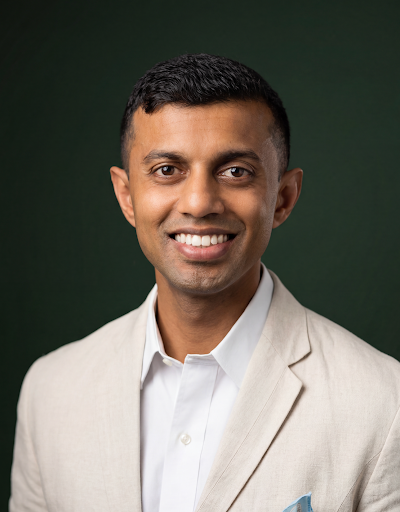
Vineet Rajan is the Co-Founder and CEO of Forte, a public benefit corporation building mental fitness at organizational scale for hundreds of mission-driven organizations, including schools and districts. He often speaks and writes on what it means to be fully human in the 21st century. His work rests on one claim: organizations rarely collapse. They drift. And drift is not a scheduling problem or a wellness problem. It is a conditioning problem.
That conviction was formed over more than a decade as a Marine Corps intelligence officer, leading teams in Iraq and Afghanistan, serving at the Pentagon and as an exchange officer with the UK Ministry of Defence, and working as a Congressional Fellow on Capitol Hill. He later invested in mission-driven companies with Acumen America and consulted for the Skoll Foundation.
Vineet holds an MBA from the Stanford Graduate School of Business and a Masters from Cambridge (w/ Distinction). He is a Praxis Fellow, a Strategic Advisor to the Founders Mental Health Pledge, a recognized expert on AI and Faith, and a member of the Christian Economic Forum. His work has been featured in Axios and Christianity Today. He lives outside Washington, D.C. with his wife, Sandhia, and their children, Nehemiah and Neylah.
CESA Partnership Spotlight
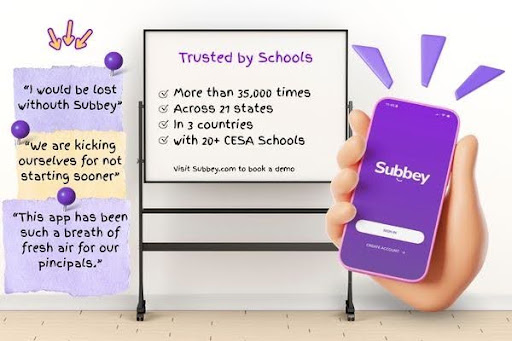
Trusted by 20+ CESA schools and used 35,000+ times — Subbey is the substitute management system built for independent schools.
Subbey eases the chaos of finding substitutes with one intuitive app built just for your school. Subs claim jobs instantly via real-time notifications, teachers chat directly with subs in-app, every absence lives on one user-friendly calendar, and admins run payroll-ready reports in a click.